Whether you are replacing a boiler, adding capacity or bringing in a temporary unit while a repair is underway, the first question is always the same: how big does it need to be? In commercial and industrial work, that answer is usually given in boiler horsepower. This guide explains what boiler horsepower means, how it converts to BTU per hour and pounds of steam, and which load questions actually decide the size of a commercial boiler.
What boiler horsepower means
Boiler horsepower (BHP) is not the same thing as engine or motor horsepower. It is an older unit that describes how much steam a boiler can make, and it is still the standard way commercial and industrial boilers are rated in the United States.
- 1 boiler horsepower = 33,475 BTU per hour of heat output.
- That equals about 34.5 pounds of steam per hour "from and at 212°F", meaning water at 212°F turned into steam at 212°F at atmospheric pressure.
- In electrical terms, 1 BHP is roughly 9.8 kW of heat output.
So a 100 BHP boiler produces about 3.35 million BTU per hour, or roughly 3,450 pounds of steam per hour from and at 212°F. A 500 BHP boiler produces about 16.7 million BTU per hour.
Why actual steam output is lower than the rating
The "from and at 212°F" figure is a reference condition, not what most plants see. Real boilers are fed with water cooler than 212°F and usually make steam at a higher pressure, so each pound of steam takes more heat. As a result, the pounds of steam per hour a boiler delivers in your plant is usually lower than the simple BHP × 34.5 number. Engineers size equipment using the actual feedwater temperature and operating pressure, along with the burner's rated input and the boiler's efficiency.
The same caution applies to hot water boilers. Their output is normally stated in BTU per hour, and the capacity you can use depends on the supply and return temperatures your system runs at.
The questions that drive boiler sizing
What is the load?
For a process, start with the steam rate each piece of equipment needs, in pounds per hour, and the pressure it needs it at. For space heating or domestic hot water, start with the peak BTU per hour demand. Nameplate data, metering and production schedules are better sources than a guess.
What does the load look like over time?
A steady 24-hour load, a load that swings widely through the day and a load with a big morning warm-up each favor a different setup. Peak demand sets the minimum capacity, but the low end matters too, because a boiler that spends most of its time far below its rating cycles more and wastes fuel.
Steam or hot water?
Process heating, sterilizing and many industrial uses need steam. Comfort heating and many building systems run better on hot water. Our comparison of hot water vs. steam boilers covers the tradeoffs.
What are the losses?
The boiler must cover more than the equipment load. Piping heat loss, blowdown, deaerator steam, condensate that is not returned and startup warm-up all add to what it has to produce. These are easy to forget and can add a meaningful margin on a large system.
How much redundancy do you need?
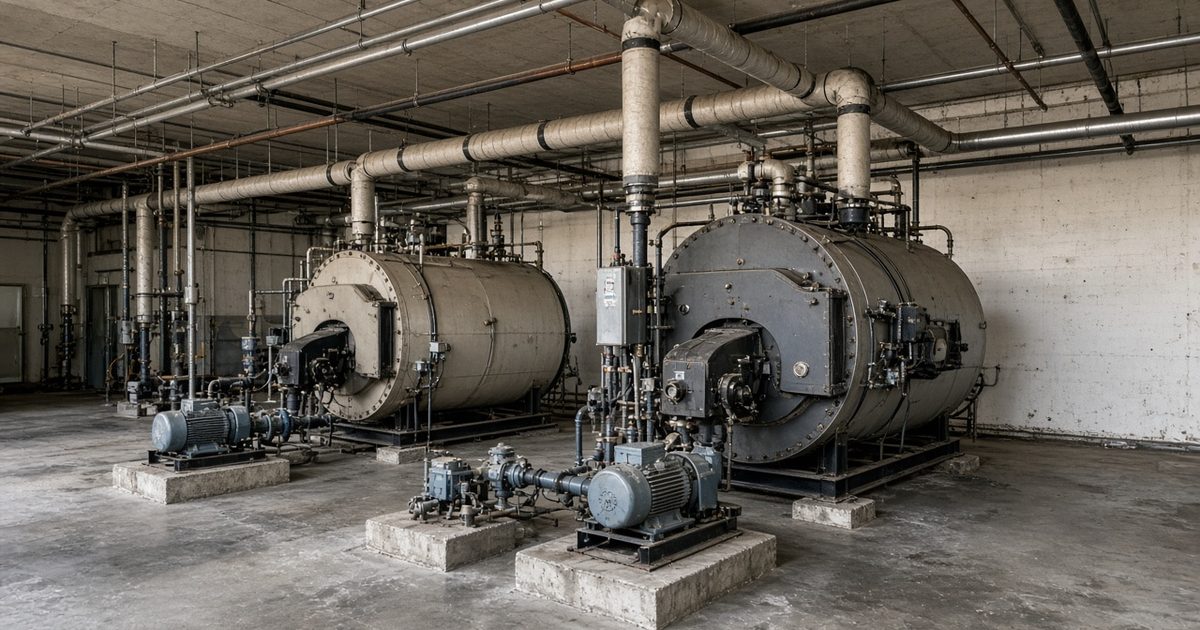
Many facilities use two or more boilers so one can be serviced without shutting down, or design for N+1 capacity on critical systems. Splitting capacity also helps at low load, because one smaller boiler can carry light demand efficiently.
What fits the site?
Footprint, gas supply pressure and volume, electrical service, stack and combustion air, water treatment and access for service all affect which boiler you can install. A unit that looks right on paper may not fit the room or the utilities.
A simple sizing example
Suppose a plant's process equipment needs a combined 4,000 pounds of steam per hour, and the team estimates another 10 percent for piping losses, blowdown and the deaerator. That brings the requirement to about 4,400 pounds per hour. Dividing by 34.5 gives roughly 128 BHP at the reference condition, but because the plant feeds cooler water and runs at higher pressure, the engineer checks the manufacturer's output data at the actual conditions before choosing a size. The team might then decide on two smaller boilers instead of one large one, so production can continue if one unit is down. The arithmetic is a starting point; the operating conditions and the plant's tolerance for downtime finish the decision.
Oversizing has a cost
Bigger is not automatically safer. An oversized boiler tends to short cycle, turning on and off far more than it should. That wears out burners and controls, lowers efficiency at partial load and costs more to buy, install and maintain. If your current boiler cycles constantly, our guide to commercial boiler short cycling explains the common causes. Modulating burners with good turndown, and multiple smaller boilers, help match output to demand.
Sizing a temporary or rental boiler
When a boiler fails or is being replaced, the rental unit has to carry the critical load, which is not always the full nameplate of the original boiler. If you know your real demand, the steam pressure or water temperature you need and the utilities available at the connection point, the right unit can be matched and delivered faster. Our boiler rental team can help you work through those numbers.
Repair, replace or right-size?
A failing boiler is a chance to check whether the original size still fits the facility. Processes change, buildings get added and loads drop when equipment is retired. Before you order a like-for-like replacement, it is worth reviewing your actual load. Our guide on when to repair vs. replace a commercial boiler walks through that decision.
Frequently asked questions
How many BTU are in one boiler horsepower?
One boiler horsepower equals 33,475 BTU per hour of output.
How much steam does one boiler horsepower make?
About 34.5 pounds of steam per hour from and at 212°F. Actual output at your feedwater temperature and operating pressure will be lower.
Is boiler horsepower the same as motor horsepower?
No. Boiler horsepower is a measure of steam or heat output, and one boiler horsepower is roughly 13 times the heat equivalent of one mechanical horsepower.
Get help sizing your boiler
Boilers on Demand helps Houston-area facilities with boiler installation, boiler sales and rentals. Tell us about your load, your current equipment and your timeline, and we will help you work out the right size. Request a quote or call 936-300-4111.